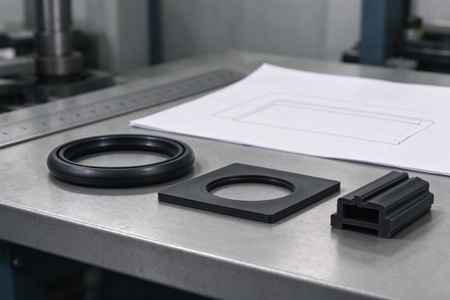
Custom rubber O-rings are used in many sealing applications where standard sizes, materials or performance requirements may not meet the design specifications. For equipment manufacturers, distributors and industrial buyers, choosing the correct O-ring involves more than matching its diameter.
Dimensions, rubber compound, hardness, gland design, operating conditions and production requirements all affect sealing performance. This guide explains what to consider when sourcing custom rubber O-rings from an OEM supplier.
When Do You Need Custom Rubber O-Rings?
Standard O-rings are available in many established size systems. However, a custom solution may be worth evaluating when:
- The required dimensions are not available in the standard sizes you use.
- An existing O-ring must be reproduced for equipment maintenance or replacement.
- The application requires a particular rubber compound or hardness.
- The O-ring must fit a specially designed groove or sealing assembly.
- OEM production requires defined specifications, repeatability or product identification.
Before requesting a custom size, check whether a suitable standard O-ring can meet the dimensional and performance requirements. A standard option may reduce tooling needs, lead time or sourcing complexity.
How to Specify O-Ring Dimensions
Two key dimensions define a conventional O-ring: its inside diameter and cross-section diameter. Both are important when identifying a replacement or specifying a new design.
1. Inside Diameter (ID)
The inside diameter is the diameter of the open space inside the O-ring when it is not installed. Measure it carefully, particularly when the ring is small, worn or stretched.
2. Cross-Section Diameter (CS)
The cross-section diameter is the thickness of the O-ring material. It affects how the ring fits into the gland and how much it is compressed during installation.
3. Tolerances and Measurement Method
Record the units used, such as millimeters or inches, and specify critical tolerances when they are known. If measuring an existing sample, note whether it is new, worn, swollen, flattened or permanently deformed.
For a custom design, a dimensioned drawing is preferable. If no drawing is available, provide clear photographs and measured dimensions, and ask the supplier to confirm the proposed specifications before production.
Which Rubber Material Should You Choose?
The correct material depends on the fluid being sealed, temperature range, pressure, movement, environment and expected service life. Common options include the following.
| Material | Common selection reasons | What to verify |
|---|---|---|
| NBR | Often considered for mineral-oil and grease applications | Exact fluid compatibility, temperature, ozone and weather exposure |
| EPDM | Often considered for water, outdoor weathering and selected environmental sealing applications | Compatibility with the actual fluid, especially petroleum-based oils |
| Silicone | Often considered when flexibility and a broad temperature range are important | Tear strength, wear, compression behavior and fluid compatibility |
| FKM | Often considered for demanding temperature or chemical-resistance requirements | Specific chemicals, temperature limits, compound grade and cost |
These are general guidelines, not universal performance guarantees. Different formulations of the same rubber family can behave differently. Confirm the specific compound against the actual operating conditions.
For more information, visit our rubber materials page.
O-Ring Hardness and Compression
Rubber hardness is commonly expressed using the Shore A scale. Hardness influences how an O-ring deforms under load, but it should not be selected in isolation.
The appropriate hardness depends on factors such as:
- Pressure and the possibility of extrusion into clearance gaps.
- Gland dimensions and intended compression.
- Whether the seal is used in a static or dynamic application.
- Assembly forces and the risk of installation damage.
- Temperature and the behavior of the selected rubber compound.
Excessive compression can accelerate damage or increase friction, while insufficient compression may cause leakage. Gland geometry and the manufacturer's design recommendations should be reviewed together with material hardness.
Static vs. Dynamic O-Ring Applications
Static Sealing
Static O-rings seal between components that do not move relative to each other during normal operation. Examples include certain covers, flanges, housings and threaded assemblies.
For static applications, buyers should confirm the groove dimensions, mating surfaces, compression requirements, pressure and fluid exposure.
Dynamic Sealing
Dynamic O-rings are used where relative movement occurs, such as in some reciprocating or rotary assemblies. Friction, wear, lubrication, speed, heat generation and extrusion risk become particularly important.
A material and design suitable for a static seal should not automatically be assumed suitable for dynamic service. Share the movement type and operating conditions with the supplier.
Custom O-Ring Manufacturing and OEM Requirements
Manufacturing methods depend on the O-ring design, material, size, required quantity and production capability. Some projects may use existing tooling or standard sizes, while other designs may require dedicated tooling or additional engineering review.
When evaluating an OEM quotation, clarify the following:
- Whether the quoted product uses existing tooling or requires new tooling.
- Whether tooling costs are included or quoted separately.
- How dimensions, hardness and material specifications will be verified.
- Whether samples can be reviewed before mass production.
- What inspection records, material documents or packaging options are available.
- Whether the supplier can support repeat orders to the agreed specifications.
Requirements vary by product and supplier, so confirm the available processes and inspection capabilities for your specific project. Learn more about our OEM and custom manufacturing services.
What to Include in an O-Ring RFQ
A clear request for quotation helps suppliers assess feasibility and prepare a more useful response. Include as many of the following details as possible:
- Product: O-ring, replacement seal or custom design.
- Dimensions: Inside diameter, cross-section and drawing if available.
- Material: Required rubber type or the application details needed to evaluate it.
- Hardness: Target Shore A value and tolerance, if specified.
- Application: Static or dynamic use, working fluid, temperature and pressure.
- Quantity: Sample quantity, initial order quantity and estimated repeat demand.
- Quality: Critical tolerances, inspection requirements and documentation.
- Delivery: Destination country and requested delivery schedule.
If you have an existing O-ring but no drawing, photographs and careful measurements can support an initial review. The final dimensions and material should be confirmed before production.
Common Mistakes When Sourcing Custom O-Rings
- Matching the inside diameter but overlooking the cross-section.
- Choosing a rubber material without checking the actual fluid and temperature.
- Using an old or swollen sample as the only reference for final dimensions.
- Ignoring groove design, compression or extrusion clearance.
- Assuming a static O-ring design will work in a dynamic application.
- Requesting a quotation without quantity, tolerance or quality requirements.
Request a Custom Rubber O-Ring Quotation
QWS supports inquiries for rubber sealing products and custom manufacturing requirements. To help review your O-ring project, provide the dimensions or drawing, material requirements, operating conditions and expected order quantity.
If some specifications are not yet available, explain the application and identify what still needs to be confirmed.
Related pages:
Frequently Asked Questions
Can custom rubber O-rings be made from a sample?
A sample can help a supplier review the design, but its condition matters. Wear, swelling, compression set or deformation can affect measurements. Confirm the final specifications before manufacturing.
How do I measure an O-ring correctly?
Measure the inside diameter and cross-section diameter, and record the units. For critical applications, use appropriate measuring tools and a technical drawing or verified specification whenever possible.
Which material is best for oil-resistant O-rings?
NBR and FKM are commonly evaluated for oil-related applications, but the correct choice depends on the exact oil, temperature, pressure and compound. Confirm compatibility with the supplier.
Do custom O-rings always require new tooling?
No. Whether new tooling is needed depends on the design, dimensions and available manufacturing options. Ask the supplier to confirm tooling requirements and any associated costs.
For project review or a quotation request, please contact QWS with your requirements.