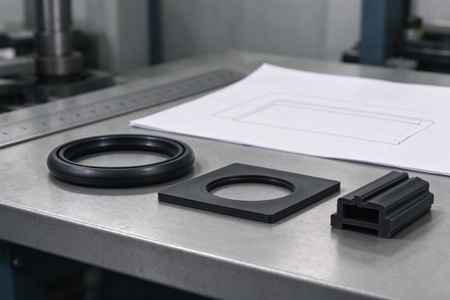
Custom rubber gaskets are used to create a seal between two mating surfaces in equipment, machinery, enclosures and many other applications. When a standard gasket does not fit the required dimensions or operating conditions, a custom design may be needed.
For buyers sourcing custom rubber gaskets from an OEM supplier, the key is to define the gasket shape, dimensions, material, operating environment and order requirements before production.
What Are Custom Rubber Gaskets?
A rubber gasket is a sealing component placed between two surfaces to help prevent the unwanted passage of liquids, gases, dust or other substances. Its performance depends on the gasket design, rubber compound, compression, surface condition and operating environment.
Custom rubber gaskets can be manufactured in different shapes, thicknesses, sizes and rubber materials to meet application-specific requirements.
Common Types of Custom Rubber Gaskets
1. Flat Rubber Gaskets
Flat rubber gaskets are typically cut or molded into a defined shape. They may have round, rectangular, irregular or application-specific outlines, with holes or cutouts where required.
Buyers should provide the outer dimensions, inner openings, thickness and any critical features that affect fit or sealing.
2. Die-Cut Rubber Gaskets
Die-cut gaskets are produced by cutting rubber sheet material into a required profile. This method may be suitable for flat gasket designs, depending on the material, thickness, geometry and production volume.
For repeat orders, buyers should confirm dimensional requirements, material specifications and acceptable tolerances with the supplier.
3. Molded Rubber Gaskets
Molded rubber gaskets are formed using a mold to create a specific shape or profile. Molding may be appropriate for complex geometries, integrated features or designs that cannot be made effectively from flat sheet material.
Tooling requirements, design complexity and order quantity can affect the manufacturing method and total cost.
4. Custom Rubber Sealing Profiles
Some applications require a continuous or specially shaped rubber profile rather than a flat gasket. These products may be used in equipment enclosures, access panels, doors or other assemblies.
For profile-based designs, provide a cross-section drawing or sample, the required length, joint details and installation conditions.
How to Choose a Rubber Material for Gaskets
The correct rubber material depends on the actual working conditions. A material suitable for outdoor exposure may not be suitable for continuous contact with a particular oil or chemical.
| Material | Typical strengths | Important considerations |
|---|---|---|
| EPDM | Often considered for outdoor weathering, water and many environmental sealing applications | Generally unsuitable for many petroleum-based oils; verify the exact fluid and compound |
| NBR | Often considered for applications involving oils and fuels, depending on the formulation | Weathering, ozone and temperature performance depend on the specific compound |
| Silicone | Often selected for a broad temperature range and flexibility | Mechanical strength, tear resistance and fluid compatibility must be checked for the application |
| FKM | Often considered for demanding heat and chemical-resistance requirements | Compatibility and cost vary by compound and operating conditions |
These are general selection guidelines, not guarantees of performance. Always confirm the exact rubber grade against the working fluid, temperature, pressure, compression and expected service life.
Learn more about available options on our rubber materials page.
What Information Is Needed for a Custom Gasket Quote?
Preparing clear specifications can help a supplier assess feasibility, select a manufacturing process and provide a more useful quotation.
1. Drawing or Physical Sample
Provide a dimensioned drawing whenever possible. If no drawing is available, send clear photographs and a physical sample if practical. Identify any worn, damaged or deformed areas that may affect measurements.
2. Dimensions and Tolerances
Include the outer dimensions, inner openings, thickness, hole positions and other critical measurements. State any required tolerances rather than assuming all dimensions have the same tolerance.
3. Material and Hardness
Specify the required rubber material and hardness if known. If the material is uncertain, explain the application and operating conditions so the supplier can review possible options.
4. Working Conditions
Describe the substances the gasket contacts, the operating and peak temperatures, pressure or vacuum conditions, compression requirements and whether the application is static or involves movement.
5. Quantity and Delivery Requirements
State the initial order quantity, estimated repeat demand, destination country and requested delivery schedule. If tooling may be needed, ask the supplier to quote tooling separately from the unit price where applicable.
Die-Cut or Molded Gaskets: Which Method Is Better?
Neither method is automatically the best choice for every project. The appropriate process depends on the gasket geometry, rubber material, thickness, tolerance requirements, production volume and tooling cost.
- Die-cutting: May suit many flat gasket designs made from sheet rubber.
- Molding: May suit complex shapes, molded features or designs requiring a three-dimensional form.
- Profile extrusion: May suit continuous rubber profiles with a consistent cross-section.
A supplier can compare suitable processes after reviewing the drawing, sample and expected order volume. For OEM options, visit our OEM and custom manufacturing page.
Common Mistakes When Ordering Custom Rubber Gaskets
- Choosing a material based only on its name without checking fluid compatibility.
- Providing the outer dimensions but omitting inner openings, thickness or hole positions.
- Failing to identify critical dimensions and tolerances.
- Ignoring compression, surface condition or the actual installation method.
- Requesting a unit price without specifying the quantity or tooling requirements.
- Assuming a sample's material can be identified accurately from its appearance alone.
Request a Custom Rubber Gasket Quotation
QWS supports inquiries for rubber sealing products and custom manufacturing requirements. To help us review your project, prepare the drawing or sample details, dimensions, material requirements, application conditions and estimated quantity.
If you are still developing the design, you can also share the information currently available and identify the specifications that need confirmation.
Related pages:
Frequently Asked Questions
Can I order custom rubber gaskets without a drawing?
In many cases, an initial review can begin with clear photographs, measurements, a physical sample and application details. A production-ready drawing or confirmed specifications may still be required before manufacturing.
Which rubber material is best for custom gaskets?
There is no single best material for every application. Selection depends on the working fluid, temperature, pressure, compression, environment and expected service life.
Are die-cut gaskets cheaper than molded gaskets?
Not always. Die-cutting may avoid the mold tooling required for some molded designs, but total cost also depends on material usage, geometry, production quantity, tolerances and finishing requirements.
What should I include in an RFQ for rubber gaskets?
Include a drawing or sample, dimensions, tolerances, material and hardness requirements, working conditions, order quantity, destination and delivery expectations. Clearly identify any specifications that remain undecided.
For a quotation or technical review, please contact QWS with your project details.