Can You Get a Custom Rubber Seal Quote Without a Drawing?
Need a custom rubber seal but do not have an engineering drawing? You may still be able to start a quotation inquiry. Existing samples, product photos, basic measurements and application details can help a supplier understand your requirements.
However, a photograph alone usually cannot confirm every dimension, tolerance or material specification. This guide explains what information to prepare, what can be assessed initially, and how to move forward with a custom rubber seal inquiry.
Quick answer
You do not always need a complete engineering drawing to begin a discussion about a custom rubber seal. Start with the information you have, such as a physical sample, clear photos, known dimensions and the intended application. Additional measurements or technical confirmation may be needed before a final quotation or production specification can be established.
Contents
- Can you request a quote without a drawing?
- What information should you prepare?
- Are photos enough to identify a rubber seal?
- Which measurements are useful?
- What affects the quotation?
- How to start your inquiry
1. Can You Request a Quote Without a Drawing?
Yes, you can usually begin an initial inquiry without a complete technical drawing. The available information determines how accurately the supplier can identify the part and evaluate your requirements.
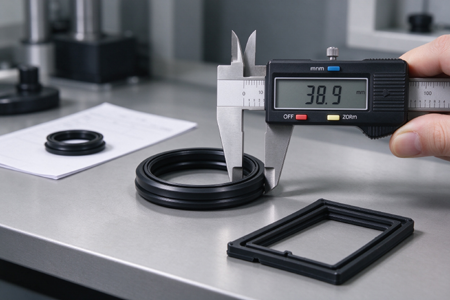
For example, an existing rubber seal can provide useful clues about its shape, installation position and function. Photos and basic measurements may help explain the requirement when a physical sample is unavailable.
There is an important distinction between an initial inquiry and a confirmed production specification. A supplier may need more information to verify dimensions, tolerances, material properties and other technical requirements before confirming a final quotation.
- Have a physical sample? Explain whether it is an original part, a used part or a replacement sample.
- Have photos but no sample? Include several views and any known measurements.
- Have only a general description? Explain where the seal is installed and what it needs to do.
2. What Information Should You Prepare?
You do not need to have every detail available before contacting a supplier. Start with the information you know and identify anything that still needs to be confirmed.
| Information | What to provide |
|---|---|
| Product photos | Clear views from different angles, including the cross-section when possible. |
| Physical sample | Describe the sample condition and whether it represents the required final product. |
| Known dimensions | Record available diameters, widths, thicknesses, lengths or other relevant measurements. |
| Material requirements | Specify the known rubber material or explain the operating conditions that may affect material selection. |
| Application | Explain where the seal is used and whether it contacts oil, water, chemicals or other substances. |
| Order quantity | Provide the estimated sample quantity and expected production order quantity, if known. |
If you have a CAD file, PDF drawing or existing technical specification, include it with your inquiry. If not, explain which details are known and which remain uncertain.
3. Are Photos Enough to Identify a Rubber Seal?
Photos are useful for an initial discussion, but they do not always provide enough information for accurate manufacturing or pricing.
A photograph can help show the general shape, visible damage, surface condition and approximate structure of a part. It may not reveal the exact dimensions, hidden features, material composition or dimensional tolerances.
To make photos more useful, consider including:
- A top view, side view and close-up of the cross-section.
- A ruler or measuring tool in the photo to provide a size reference.
- Pictures of the part installed in its actual application, where practical.
- A description of any cracks, deformation, wear or leakage problems.
Avoid relying on photographs alone when critical dimensions or sealing performance are involved. The required measurements and verification methods depend on the design and application.
4. Which Measurements Are Useful?
The relevant measurements depend on the type of rubber seal. Different profiles require different dimensions, so there is no single measurement list that fits every product.
- O-rings: inside diameter and cross-section thickness are common starting points.
- Rubber gaskets: overall length and width, thickness, hole positions and sealing features may be relevant.
- Custom profiles: cross-sectional shape, overall dimensions and installation details may be needed.
- Oil seals: shaft diameter, housing dimensions and seal configuration may be important, depending on the design.
These are examples, not substitutes for a product-specific drawing. If you cannot measure the part accurately, state the dimensions you know instead of guessing. A technical review may be necessary to determine the remaining requirements.
For product-specific information, see our pages about rubber O-rings, rubber oil seals and rubber gaskets.
5. What Affects the Quotation?
The quotation for a custom rubber seal depends on more than its visible shape. The supplier may need to assess several technical and commercial factors before providing a price.
- Material: the required rubber compound and its suitability for the operating environment.
- Design complexity: the profile, dimensions and manufacturing requirements.
- Tooling: whether new tooling or a mold may be required.
- Quantity: sample orders, small batches and recurring production orders may have different cost structures.
- Quality requirements: specified tolerances, inspection requirements and any relevant documentation.
- Delivery requirements: packaging, destination and requested delivery schedule.
When important specifications are missing, a supplier may need to ask follow-up questions before confirming a final price. Providing clear information at the beginning can help make the inquiry more efficient.
6. How to Start Your Custom Rubber Seal Inquiry
If you are ready to discuss a custom rubber seal, organize the information you already have and send it with a short explanation of your requirement.
Suggested inquiry checklist
- Product name or description
- Photos, drawing or sample information, if available
- Known dimensions and material requirements
- Application and operating environment
- Estimated order quantity
- Destination country and target delivery date, if known
You can send the information you have even if some details are not yet confirmed. Clearly identify unknown specifications so they can be reviewed before a final quotation or production decision.
Learn more about our custom rubber seals or visit our OEM and custom manufacturing page.
Frequently Asked Questions
Can I request a custom rubber seal quote with only a photo?
A photo may be enough to begin an initial discussion, but it may not provide the dimensions, material details or tolerances needed for a confirmed quotation. Additional information may be required.
Can a rubber seal be reproduced from an existing sample?
An existing sample can help identify the product's shape and dimensions. Whether it can be reproduced depends on the design, material requirements, condition of the sample and the information available for verification.
Do I need to know the rubber material before asking for a quote?
Not necessarily. If the material is unknown, describe the operating temperature, contact media, exposure conditions and intended function. These details may help the supplier assess possible material options, subject to technical review.
What if I do not know the exact dimensions?
Provide any known measurements and explain which dimensions remain unknown. Do not guess critical dimensions. Further measurement or technical confirmation may be needed before the specification can be finalized.
What should I include in an email inquiry?
Include your product description, available photos or drawings, known dimensions, application details and estimated quantity. Mention any requirements that are still uncertain so they can be discussed during the inquiry process.
Need Help With a Custom Rubber Seal?
Send the drawings, sample photos, known dimensions or application details you have available to start an inquiry.
Contact QWSEmail: sales@weqws.com